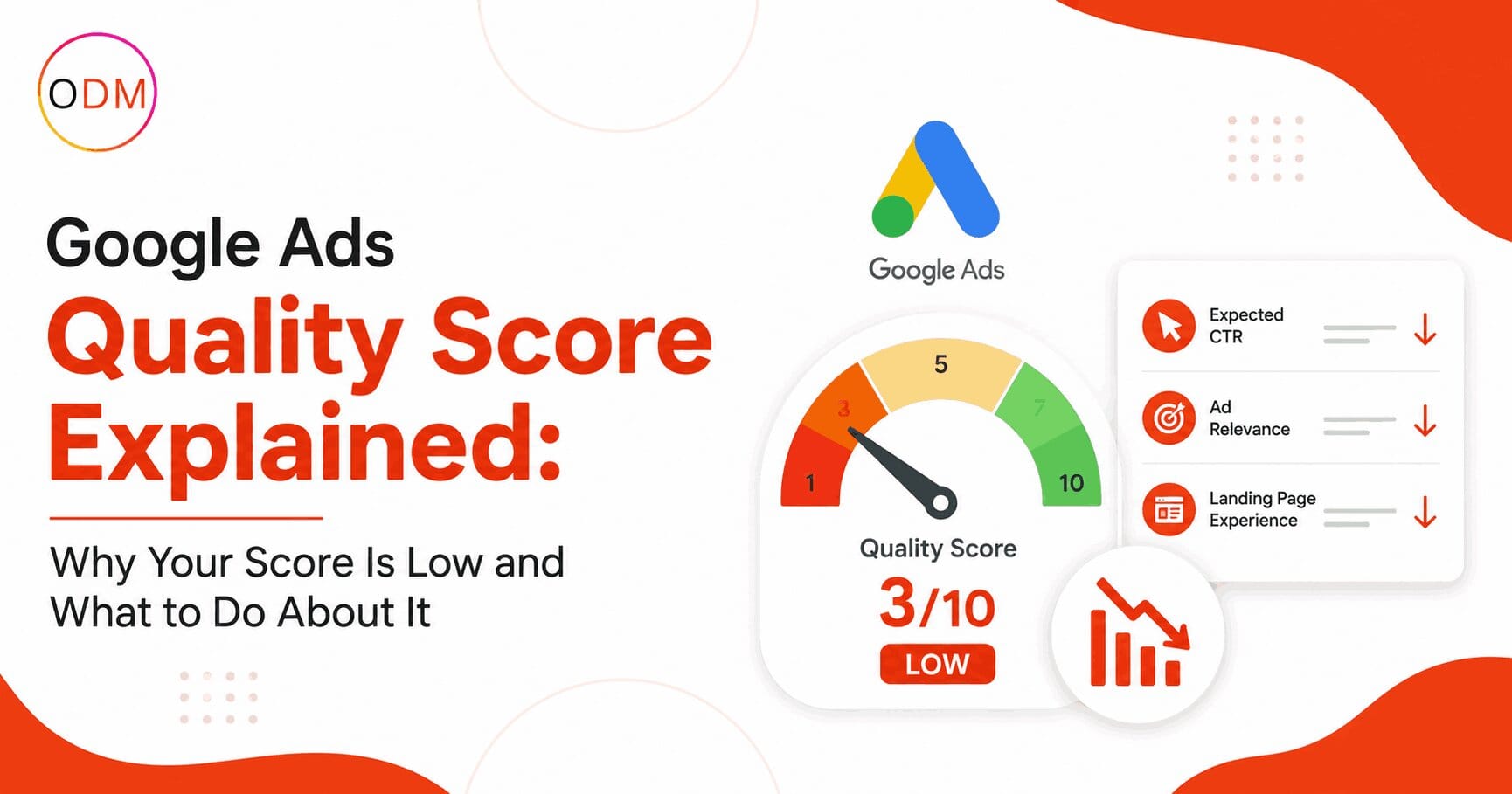
If you are running Google Ads and your cost per click keeps rising while your ad position stays poor, a low Quality Score is most likely behind it. Google Ads Quality Score explained simply means this: it is a rating from 1 to 10 that Google gives each of your keywords based on how relevant your ad, your keywords, and your landing page are to what someone just searched. A score of 5 is average. A score below 5 means you are paying more than you should and appearing lower than your competitors. Understanding this metric is the first step to fixing it, and this guide covers exactly that.
What Is Google Ads Quality Score and How Does It Work?
Google Ads Quality Score is a diagnostic metric, not a direct auction input. Google assigns it at the keyword level across your Search campaigns. The score runs from 1 to 10, and it reflects three specific factors that Google measures every time your keyword is triggered in a search.
Those three factors are:
- Expected Click-Through Rate (CTR): How likely is someone to click your ad when they see it, compared to other ads for the same keyword?
- Ad Relevance: How closely does your ad copy match the intent behind the search query?
- Landing Page Experience: Once someone clicks, does the page they arrive on match what they searched for, load quickly, and give them what they came for?
Each of these three factors is rated as Above Average, Average, or Below Average. Your overall Quality Score is a combined reflection of all three.
A score of 7 or above puts you ahead of the majority of advertisers. According to data from over 15,000 Google Ads accounts, the average Quality Score across most accounts sits between 5 and 6. If yours is regularly sitting at 3 or 4, you have a meaningful problem that is costing you money every single day.
Why Does Quality Score Matter So Much for Your Ad Budget?
Quality Score directly affects two things that determine the success of any campaign: how much you pay per click, and where your ad appears.
Google calculates Ad Rank using your bid multiplied by Quality Score and several other auction-time factors. This means an advertiser with a lower bid but a higher Quality Score can outrank an advertiser spending more money. In practice, a jump from a Quality Score of 5 to 8 can reduce your cost per click significantly, allowing your budget to go further without increasing spend.
For businesses managing tight ad budgets, this is not a minor detail. It is the difference between a campaign that generates profitable leads and one that drains money with little return.
Good google ads campaign management always treats Quality Score as a performance priority, not an afterthought.
The 5 Most Common Reasons Your Quality Score Is Low
Most accounts with low Quality Scores have the same set of problems. Here is what to look for.
1. Your Ad Copy Does Not Match the Search Query
If someone searches “affordable web design for small business” and your ad headline says “Professional Digital Solutions,” Google sees a weak connection. Ad relevance suffers, and your score drops. Your headline should reflect the search intent closely and ideally include the keyword itself.
2. Your Ad Groups Are Too Broad
Grouping 40 loosely related keywords into one ad group is one of the most common structural errors in Google Ads. When keywords are too varied, no single ad can stay relevant to all of them. Tightly themed ad groups with 10 to 20 closely related keywords perform far better.
3. Your Landing Page Is Generic or Mismatched
Sending everyone to your homepage is a Quality Score killer. Google evaluates whether the page someone lands on is relevant to what they searched. A generic page about your whole business does not satisfy someone searching for a specific service or product.
4. Your Expected CTR Is Below Average
If your ads have been running for a while with poor click-through rates, Google uses that historical data against you. It signals that searchers are not finding your ads relevant enough to click.
5. Slow Page Speed and Poor Mobile Experience
A landing page that takes more than 3 seconds to load on mobile creates bad engagement signals. High bounce rates and low time on page feed back negatively into Google’s assessment of your landing page experience.
How to Improve Quality Score in Google Ads: A Step-by-Step Approach
Knowing how to improve quality score google ads requires working on all three components in a structured way. Here is a practical sequence that works.
Step 1: Audit Your Ad Groups
Start with your campaign structure. Review every ad group and check whether the keywords inside it share a clear, single intent. If they do not, split them up. Tightly grouped keywords allow you to write ad copy that is genuinely relevant to all of them.
Step 2: Rewrite Ad Headlines Around Keyword Intent
For each ad group, your headline should reflect the primary keyword and the intent behind it. If someone is searching for a specific service, your headline should name that service directly. Avoid vague brand language at the headline level.
Step 3: Build Dedicated Landing Pages per Ad Group
This is where many advertisers fall short. Each major ad group should have its own landing page, built around the same topic as the keywords. The page content, headline, and call to action should all align with what the searcher expected when they clicked.
Step 4: Add Negative Keywords
Irrelevant traffic drags down your CTR, which in turn lowers your Quality Score. Regularly adding negative keywords removes searches that have no chance of converting and keeps your CTR healthy.
Step 5: Test Ad Variations Continuously
Run at least two versions of each ad and let performance data tell you which one connects better with your audience. Over time, consistent A/B testing raises your expected CTR and improves your score.
Step 6: Check Page Speed and Core Web Vitals
Use Google’s PageSpeed Insights tool to identify speed issues on your landing pages. Slow-loading pages create poor user signals that directly affect landing page experience scores.
This step-by-step approach is what proper how to improve quality score google ads work looks like in practice. It requires time, attention, and campaign-level thinking, not just small tweaks to ad copy.
What a Real Low Quality Score Situation Looks Like
Consider a mid-sized e-commerce business selling customised gift products. They had been running Google Ads for eight months and were spending around £3,000 per month. Their campaigns had over 60 keywords across five ad groups, all pointing to the same homepage.
When a google ads audit service was carried out, three issues came up immediately. First, 70% of keywords had a Quality Score of 4 or below. Second, ad copy was using the same generic headlines across different product categories. Third, the homepage loaded in 6.2 seconds on mobile.
After restructuring the account into 14 tightly themed ad groups, creating eight dedicated landing pages, and cutting page load time to under 2.5 seconds, the average Quality Score across the account moved from 4.1 to 6.8 over 90 days. Cost per click dropped by 34%, and conversions increased by 41% on the same budget.
This is what the combination of a proper google ads audit service and active google ads campaign management actually produces in practice.
Is Your Account Structured in a Way That Supports a Good Quality Score?
Before making any changes, ask yourself these questions honestly:
- Do each of your ad groups contain keywords that share one clear intent?
- Does your ad headline directly reflect what someone searching that keyword is looking for?
- Does each keyword in your account have a dedicated or highly relevant landing page?
- When was the last time you reviewed your negative keyword list?
- Have you checked your landing page speed on mobile in the last 30 days?
If you answered no to two or more of these, your account structure is likely the reason your Quality Score is low, not your budget.
Your Quality Score Is Costing You Money Right Now
Every day you run Google Ads with a low Quality Score, you are paying more per click than you need to and appearing in lower positions than your budget should earn. The fix is not to spend more. The fix is to make your campaigns more relevant at every level.
Getting there requires a structured google ads audit service to find exactly what is broken, followed by ongoing google ads campaign management to keep things optimised as your campaigns grow and evolve.
The team at Online Dot Marketing works with businesses to identify Quality Score problems, restructure accounts, build high-relevance landing pages, and put proper google ads campaign management systems in place that keep costs down and results improving. If your campaigns are underperforming and you want a clear picture of why, a google ads audit service is the right starting point.
FAQ: Google Ads Quality Score Questions Answered
What is a good Quality Score in Google Ads?
A Quality Score of 7 or above is considered good and puts you ahead of most advertisers. A score of 5 is average. Anything below 5 signals a relevance problem in your ad copy, keywords, or landing page that is likely increasing your cost per click and lowering your ad position significantly.
How often does Google update Quality Score?
Google updates Quality Score continuously, each time a keyword is triggered in a search auction. However, the visible score shown in your account is a lagging indicator. You may not see changes reflected in the interface immediately after making improvements to your ads or landing pages.
Can a high bid compensate for a low Quality Score?
A higher bid can partially offset a low Quality Score in Ad Rank calculations. However, it is not a sustainable strategy. You end up paying significantly more per click than a competitor with a better score. Improving Quality Score is always more cost-effective than simply raising bids without addressing relevance.
Does Quality Score affect all campaign types in Google Ads?
Quality Score applies specifically to Search campaigns at the keyword level. Performance Max campaigns do not use keyword-level Quality Score. Instead, Google evaluates asset group ratings such as Low, Good, or Best based on the relevance and quality of the creative inputs you provide across headlines, descriptions, and images.
How does landing page experience affect Quality Score?
Landing page experience is one of the three components Google uses to calculate Quality Score. Google assesses how relevant, useful, and fast your page is for the person who clicked your ad. A page that does not match the search intent, loads slowly, or has a high bounce rate will receive a Below Average rating, pulling down your overall score.
What is the fastest way to improve a low Quality Score?
The fastest improvement usually comes from fixing your ad copy to match keyword intent more closely and separating broad ad groups into tightly themed ones. These changes affect ad relevance and expected CTR relatively quickly. Landing page improvements take longer to register but have significant long-term impact on your cost per click.