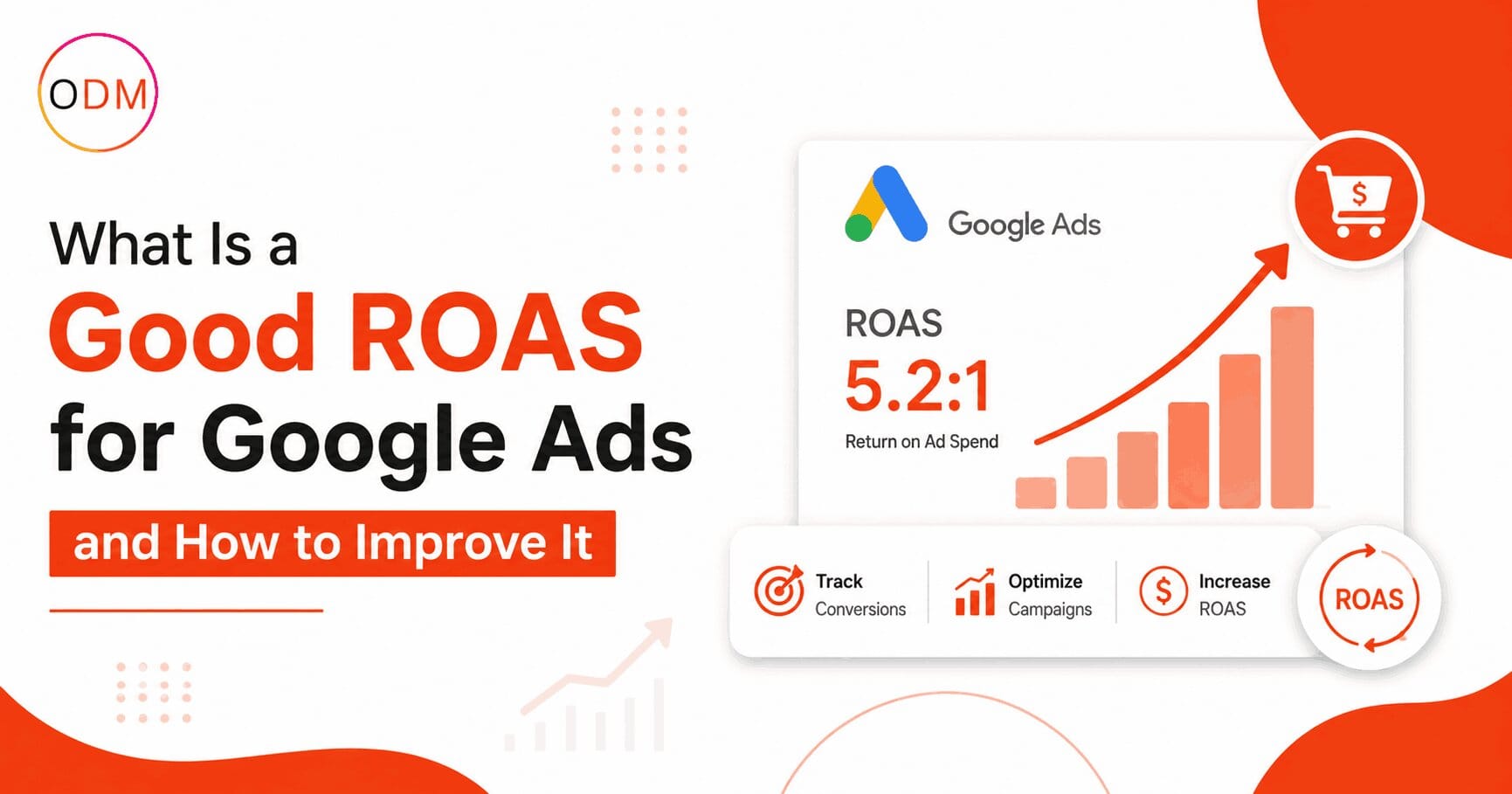
Running Google Ads without knowing your ROAS is like driving without a dashboard. What is good ROAS Google Ads campaigns should achieve? For most businesses, a 4:1 ratio (400%) is considered the standard baseline, meaning £4 or $4 returned for every £1 or $1 spent. But that number changes depending on your margins, industry, and goals. Many ecommerce businesses struggle here, not because their ads are bad, but because they lack the right measurement, bidding strategy, or account structure to push performance forward. Getting this right is where real revenue growth begins.
What Does ROAS Actually Mean and Why Does It Matter?
ROAS stands for Return on Ad Spend. The formula is simple:
ROAS = Revenue Generated / Ad Spend
So if you spend $1,000 on Google Ads and generate $5,000 in sales, your ROAS is 5:1 or 500%.
ROAS tells you how efficiently your ad budget is working. Unlike ROI, it does not account for product costs or overheads, so it is purely a revenue-to-spend ratio. That is why your target ROAS needs to be calibrated against your profit margins, not just your revenue figures.
A 3:1 ROAS might be profitable for a high-margin digital product. The same ratio could mean losses for a low-margin physical product with shipping and fulfilment costs.
What Is a Good ROAS for Google Ads Across Different Industries?
What is good ROAS Google Ads benchmarks suggest varies by sector. Here is a general guide based on industry data:
Typical ROAS benchmarks by industry:
- Ecommerce (general retail): 4:1 to 6:1
- Fashion and apparel: 3.5:1 to 5:1
- Electronics: 5:1 to 8:1
- Home and garden: 4:1 to 6:1
- Health and beauty: 3:1 to 5:1
- B2B lead generation: 2:1 to 4:1 (measured differently)
These are starting points, not targets to chase blindly. A business with a 70% gross margin can afford a lower ROAS than one running on 20% margins.
The real question is: what ROAS do you need to break even?
Use this formula to find your minimum ROAS:
Minimum ROAS = 1 / Gross Margin %
If your gross margin is 40%, your break-even ROAS is 2.5:1. Anything above that is profitable. Anything below that means you are losing money on every sale.
How to Improve ROAS Google Ads: A Step-by-Step Approach
Learning how to improve ROAS Google Ads performance requires a structured process, not random tweaks. Here are the core steps that consistently move the needle:
Step 1: Audit your conversion tracking
If your conversions are not tracked correctly, your ROAS data is unreliable. Make sure you are tracking actual purchases and revenue values, not just clicks or page visits. Use Google Tag Manager and verify your tags in Google Ads and Analytics.
Step 2: Restructure your campaigns by intent
Group campaigns around clear buying intent. Top-of-funnel, mid-funnel, and bottom-funnel searches need different bids, creatives, and landing pages. Mixing them into one campaign blends your data and weakens performance.
Step 3: Tighten your audience targeting
Use Customer Match, in-market audiences, and remarketing lists for search ads (RLSA). Bidding higher on users who have already visited your site or purchased before tends to produce significantly better ROAS than targeting cold traffic alone.
Step 4: Improve your landing pages
Ad quality only gets people to the page. What happens on that page determines whether they buy. Slow load times, confusing layouts, and weak calls to action kill ROAS regardless of how good the ads are.
Step 5: Use Target ROAS bidding correctly
Smart bidding through Target ROAS can work well, but only when there is enough conversion data. Google recommends at least 50 conversions in the past 30 days before switching to this strategy. Without sufficient data, the algorithm guesses rather than learns.
Step 6: Cut spend on poor performers systematically
Review your search terms, placement reports, product-level data (for Shopping), and device performance weekly. Reallocating budget from poor performers to high-ROAS segments is one of the fastest ways to lift your overall account performance.
Knowing how to improve ROAS Google Ads campaigns is one thing. Executing it consistently while managing a business is another challenge entirely.
A Real Ecommerce Business Scenario: Where ROAS Goes Wrong
Consider an online homeware store spending $8,000 per month on Google Ads, generating $22,000 in revenue. That is a 2.75:1 ROAS. The business owner assumes this is acceptable because revenue looks healthy.
The problem: their gross margin is 38%. Their break-even ROAS is 2.63:1. After factoring in agency fees and fulfilment costs, they are barely breaking even, and some months running at a small loss.
After bringing in a google ads expert for ecommerce, the audit reveals three issues:
First, the Shopping campaigns have no negative keywords and are appearing for irrelevant searches. Second, mobile traffic is converting at 0.6% while desktop converts at 3.1%, but mobile is receiving 65% of the budget due to default bidding settings. Third, the best-performing products by ROAS are not in a dedicated campaign and are competing for budget with low-margin items.
After restructuring over eight weeks, including device bid adjustments, product segmentation, and negative keyword work, ROAS climbs to 4.8:1 on the same budget. Revenue increases to $38,400 per month.
No extra spend. Same products. Better structure and management.
This is the kind of outcome a skilled google ads expert for ecommerce can achieve when they approach the account methodically rather than just adjusting bids.
Are You Making These Common ROAS-Killing Mistakes?
Take a moment to evaluate your current setup honestly:
- Are you tracking revenue values against each conversion, or just counting conversions as equal?
- Do you have separate campaigns for branded and non-branded traffic?
- Are you reviewing your search terms report at least once a week?
- Is your Shopping feed optimised with accurate titles, prices, and product types?
- Have you excluded audiences who are unlikely to convert, such as recent buyers for consumable products you want repeat purchases on (or excluded them for single-purchase items)?
If you answered no to two or more of these, your ROAS has room to grow without increasing your ad budget. The gap between where your account is now and where it could be is often structural, not creative.
How Google Ads ROAS Optimisation Service Works in Practice
A professional google ads roas optimisation service does not just adjust bids and move on. The process involves ongoing work across multiple layers of the account.
What a proper google ads roas optimisation service typically includes:
Conversion tracking audit and setup: Ensuring every pound or dollar of revenue is attributed correctly to the right campaign, ad group, and keyword.
Campaign architecture review: Looking at how campaigns are structured and whether spend is distributed in a way that reflects actual business priorities and margins.
Bid strategy management: Deciding whether manual CPC, enhanced CPC, Target ROAS, or Maximise Conversion Value is the right approach based on data volume and account maturity.
Feed optimisation (for Shopping campaigns): Product titles, descriptions, and attributes directly affect which searches trigger your ads. Poor feed quality is one of the most underestimated causes of low ROAS in ecommerce.
Weekly performance reviews: Identifying trends, catching performance drops early, and acting before issues compound over a billing cycle.
Landing page recommendations: Conversion rate optimisation (CRO) advice based on what is happening after the click, not just during the ad auction.
A quality google ads roas optimisation service treats your ad account as an asset to be managed carefully, not a set-and-forget system.
How a Google Ads Expert for Ecommerce Approaches ROAS Differently
A google ads expert for ecommerce thinks differently from a generalist PPC manager. Ecommerce accounts have unique layers of complexity: product feeds, inventory changes, seasonal demand shifts, margin differences across SKUs, and the interplay between Shopping, Search, and Performance Max campaigns.
Here is how a specialist approach differs:
Margin-first thinking: A google ads expert for ecommerce sets target ROAS at the product or category level based on actual margins, not a blanket account target. A 3:1 ROAS on a 60% margin product is excellent. The same ROAS on a 25% margin product needs immediate attention.
Feed management as a priority: Most ecommerce ROAS problems can be traced back to the product feed. Specialists treat feed quality as a first-class task, not an afterthought.
Lifecycle audience strategy: Identifying where each customer is in their journey and adjusting bids accordingly. New visitors, cart abandoners, and past purchasers should not be bid on identically.
Cross-channel attribution awareness: A google ads expert for ecommerce understands that Google Ads exists within a wider marketing mix and does not optimise in isolation.
Working with a google ads expert for ecommerce who understands these layers is what separates accounts that plateau at a 3:1 ROAS from those that reach 6:1 or beyond on the same product catalogue.
Conclusion: Getting Your ROAS Where It Needs to Be
What is good ROAS Google Ads campaigns should achieve depends on your margins, your industry, and your account maturity. A 4:1 ROAS is a widely used benchmark, but the number that matters most is the one above your break-even point.
Knowing how to improve ROAS Google Ads performance means working systematically through tracking, structure, audiences, landing pages, and bidding strategy. Each layer contributes. Fixing one while ignoring the others produces limited results.
The accounts that consistently perform well are not running the most expensive keywords or the flashiest creatives. They are structured correctly, tracked accurately, and managed by someone who understands how to balance spend against margin at scale.
A dedicated google ads roas optimisation service, run by a google ads expert for ecommerce with real experience, is what makes the difference between an ad account that treads water and one that drives consistent, scalable growth.
Ready to Stop Guessing and Start Growing?
If your Google Ads account is generating revenue but not at the ROAS it should be, the problem is almost never the products and rarely the budget. Most of the time, it comes down to structure, tracking, and management quality.
Online Dot Marketing works with ecommerce businesses as a dedicated google ads roas optimisation service, built around improving the actual return on every pound you invest in paid search.
Whether your Shopping campaigns are underperforming, your ROAS has plateaued, or you have never had a clear picture of what your ad spend is actually returning, the team can help.
Talk to a google ads expert for ecommerce at Online Dot Marketing today.
Get Your Free Google Ads Audit
Frequently Asked Questions
What is a good ROAS for Google Ads in ecommerce?
For most ecommerce businesses, a ROAS of 4:1 is a solid starting benchmark. However, a good ROAS depends on your gross margin. Calculate your break-even ROAS first, then set targets above that number to ensure genuine profitability from your ad spend.
How do I calculate my break-even ROAS?
Divide 1 by your gross margin percentage. If your margin is 40%, your break-even ROAS is 2.5:1. Any ROAS above that number means your campaigns are contributing positively to profit. Account for additional costs like fulfilment and agency fees when setting realistic targets.
How to improve ROAS Google Ads campaigns without increasing budget?
Start by auditing your conversion tracking, then review your search terms and add negative keywords. Adjust bids by device, audience, and time of day based on actual conversion data. Structural improvements and tighter targeting often lift ROAS faster than simply increasing ad spend.
What is a Google Ads ROAS optimisation service?
A google ads roas optimisation service is a managed service where specialists review and improve every layer of your Google Ads account, including tracking, structure, bidding, and feed quality, with the specific goal of increasing the revenue returned per pound or dollar of ad spend.
Why is my Google Ads ROAS dropping even when I am spending more?
Spending more without fixing underlying issues often dilutes ROAS. Common causes include poor search term matching, unoptimised product feeds, unfiltered audiences, or weak landing pages. A google ads expert for ecommerce can identify which layer is causing the decline and correct it systematically.
When should I hire a Google Ads expert for ecommerce?
Hire a google ads expert for ecommerce when your account has stalled, when you are spending more than $2,000 per month without a clear ROAS trend, or when managing the account yourself is taking time away from running the business. Specialist management typically pays for itself within the first two months.