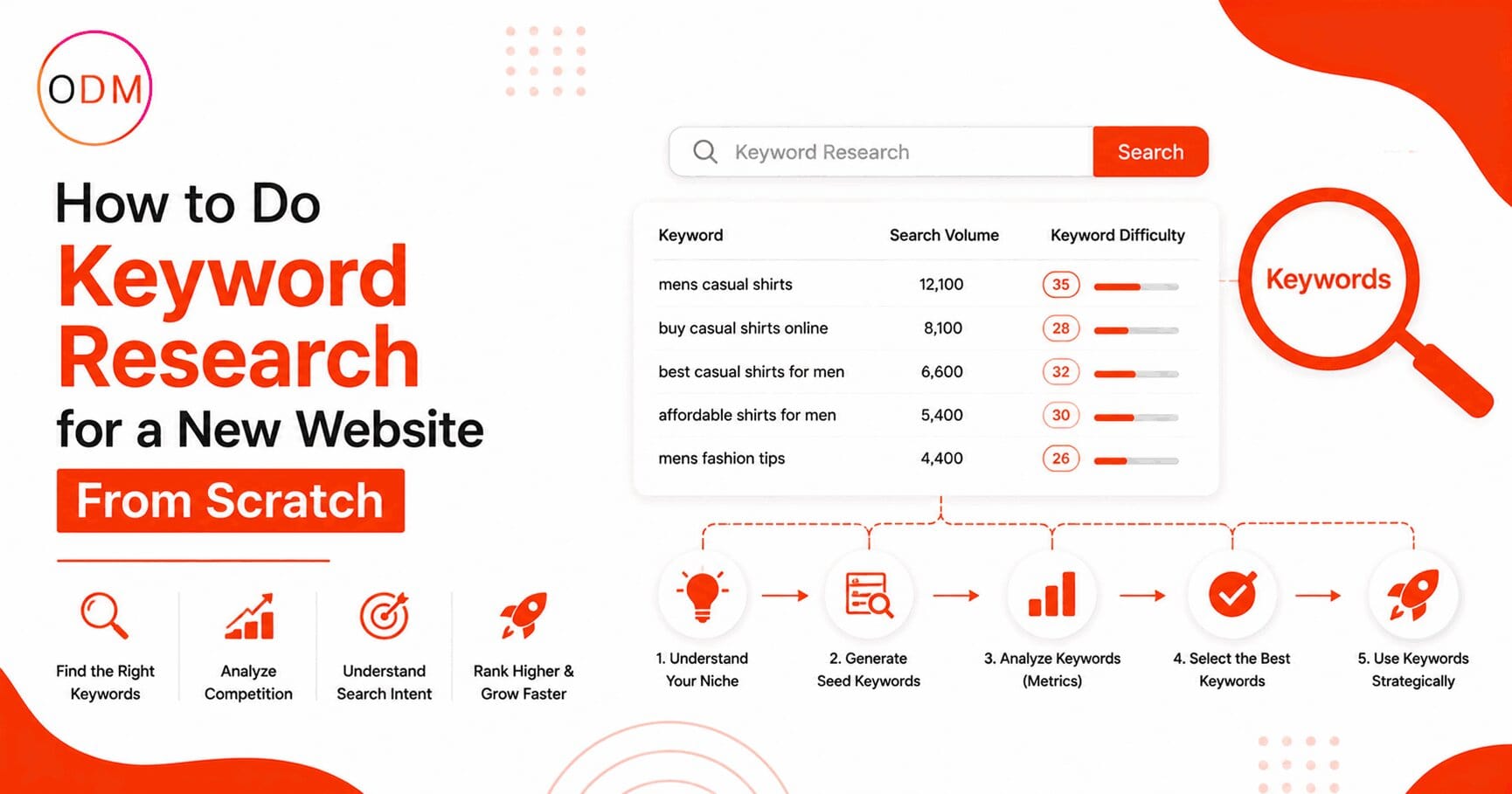
Starting a new website without a keyword strategy is like opening a shop in a city where no one knows your address. You get traffic only if people stumble upon you by accident. Keyword research for new website projects is the foundation that tells search engines what your site is about and tells potential customers that you have exactly what they are looking for. Most new website owners skip this step or do it incorrectly, and then wonder why their site gets zero organic traffic months after launch. Getting this right from day one saves time, money, and a lot of frustration.
What Is Keyword Research and Why Does It Matter for a New Website?
Keyword research is the process of finding the exact words and phrases your target audience types into Google when they are looking for products, services, or information related to your business.
For a new website, this matters more than almost anything else. Without knowing which terms people search for, you cannot create content that ranks. Without ranked content, you get no visitors. Without visitors, you get no leads or sales.
A proper understanding of how to find keywords for website seo helps you build a content and page structure that Google can index, understand, and reward with rankings.
How to Do Keyword Research for a New Website Step by Step
This is the most direct answer to the question: here is exactly how keyword research for a new website works, from zero.
Step 1: Define Your Niche and Audience
Before opening any tool, be clear on who your website serves and what problems it solves. Write down 5 to 10 topics your site covers. These become your seed topics.
Step 2: Generate Seed Keywords
Take each topic and write 3 to 5 obvious search terms a person might use. For example, if your site sells accounting software, seed keywords might include “small business accounting software” or “invoicing tool for freelancers.”
Step 3: Use Keyword Research Tools
Enter your seed keywords into tools like Google Keyword Planner, Ahrefs, Semrush, or Ubersuggest. These tools show search volume, competition level, and related keyword suggestions. Knowing how to find keywords for website seo at this stage means looking beyond just volume and checking intent.
Step 4: Analyse Search Intent
Every keyword falls into one of four intent types: informational, navigational, commercial, or transactional. Match your page type to the intent. A blog post suits informational intent. A product page suits transactional intent.
Step 5: Check Competitor Keywords
Enter your top 3 competitors into a tool like Ahrefs or Semrush. Look at which keywords are driving their traffic. Identify gaps where they rank but you do not yet have content.
Step 6: Group Keywords by Topic
Organise your keywords into clusters. Each cluster represents one page or article on your site. This structure supports topical authority, which Google rewards in 2026.
Step 7: Prioritise by Opportunity
Focus first on keywords with moderate search volume and low to medium competition. These give a new site the best chance of ranking within a reasonable timeframe.
How to Find Keywords for Website SEO Without Wasting Time
Many new website owners spend hours collecting thousands of keywords and then do nothing with them. The smarter approach is focused and structured.
Start with Google itself. Type your seed keyword into the search bar and look at the autocomplete suggestions. Scroll to the bottom of the results page and look at the “Related Searches” section. These are real phrases that real users are typing.
Use the “People Also Ask” box on Google results pages. Every question in that box is a potential blog post or FAQ entry. Answering these questions directly is one of the fastest ways to appear in Google AI Overviews.
Understanding how to find keywords for website seo also means looking at your own audience. Check forums like Reddit and Quora. Look at the language your customers use in reviews, support tickets, or social media comments. Their words are often better keywords than anything a tool will suggest.
Long-Tail vs Short-Tail Keywords: Which Should a New Website Target?
Short-tail keywords are broad, high-volume terms like “shoes” or “SEO.” They are extremely competitive. A brand new website will almost never rank for them in the short term.
Long-tail keywords are more specific phrases like “best running shoes for flat feet under 5000 rupees” or “seo keyword research service for small businesses.” They have lower search volume but much higher purchase intent and far less competition.
For a new website, long-tail keywords are where your early wins will come from. Once your domain builds authority over 12 to 18 months, you can begin competing for broader terms.
A professional seo keyword research service will map both short-tail and long-tail opportunities across your full content plan, not just pick a few random keywords and hope for the best.
What Does a Real Keyword Research Process Look Like in Practice?
Imagine a freelance interior designer in Mumbai launching her first website in early 2026. She starts by listing her services: home interiors, office design, and consultation.
She uses Google Keyword Planner and finds that “interior designer in Mumbai” gets high search volume but is also highly competitive. She then looks at longer phrases and finds “affordable home interior designer Mumbai” and “interior design consultation for 2BHK flat” both have decent monthly searches with far less competition.
She creates individual service pages targeting each cluster and writes blog posts answering questions like “how much does home interior design cost in Mumbai” and “what to ask an interior designer before hiring.”
Within four months, three of her blog posts appear on the first page for long-tail queries. Her website starts generating enquiry calls. This is not luck. Learning how to find keywords for website seo this way, with intent matching and proper clustering, is what produces results.
Is Your Current Keyword Strategy Actually Working? Ask Yourself These Questions
Before moving forward, take a moment to evaluate where you stand right now.
Do you know which keywords your website currently ranks for, even if on page 3 or 4?
Have you mapped every page on your site to a specific target keyword and search intent?
Are your blog posts and service pages structured around what users are actually searching for, or around what you assume they want?
If you cannot answer these questions with confidence, your keyword strategy has gaps. Many businesses in this position benefit significantly from an seo keyword research service that audits their existing content and builds a clear plan forward.
If you want an honest review of your current keyword setup, Online Dot Marketing can help.
How an SEO Strategy Agency Approaches Keyword Research Differently
Working with an seo strategy agency is fundamentally different from doing keyword research yourself using a free tool.
An agency brings competitor intelligence, industry benchmarks, and historical data that free tools do not provide. They understand algorithm behaviour in 2026, including how Google AI Overviews pull content and which content structures get cited.
A proper seo keyword research service from an agency includes an audit of your existing domain, gap analysis against competitors, intent mapping for every page, and a keyword prioritisation plan tied to your business goals.
Generic keyword lists are easy to produce. What separates a professional seo strategy agency from a freelancer with a spreadsheet is the ability to connect keyword data to actual revenue outcomes.
An seo keyword research service also includes regular updates. Keywords shift over time. New competitors appear. User search behaviour changes. A one-time keyword list is useful for six months at most. Ongoing refinement is what keeps rankings stable and growing.
Online Dot Marketing operates as a results-focused seo strategy agency that builds keyword strategies based on your specific market, not generic templates.
Ready to Build a Keyword Strategy That Actually Brings Results?
Keyword research for new website projects is not a one-time task. Getting the foundation right from the beginning determines whether your site ranks in three months or sits invisible for years.
Most website owners underestimate what it takes to compete in organic search. The difference between a site that generates consistent enquiries and one that gets ignored is almost always traceable back to the quality of the keyword research done at the start.
If you have a new website and want a clear plan for which keywords to target, what content to create, and how to structure your pages for search in 2026, Online Dot Marketing can put that together for you.
As a dedicated seo strategy agency, the team at Online Dot Marketing handles keyword research for new website projects, ongoing seo keyword research service management, and full search strategies built around your revenue goals, not vanity metrics.
Get in touch with Online Dot Marketing today and let’s map out a keyword strategy that gives your new website a real foundation to grow on.
FAQ: Keyword Research for a New Website
How long does keyword research take for a brand new website?
For a new website with 10 to 15 core service or product pages, thorough keyword research typically takes 3 to 5 working days. This includes competitor analysis, search intent mapping, keyword clustering, and prioritisation. Rushing the process often leads to targeting the wrong terms entirely.
What tools are best for keyword research in 2026?
Google Keyword Planner, Ahrefs, Semrush, and Ubersuggest are the most widely used tools. For newer sites with limited budgets, Google Search Console combined with free Ubersuggest features covers the basics. Paid tools provide deeper competitor and volume data for serious campaigns.
How many keywords should a new website target at launch?
A new website should focus on 1 primary keyword per page, supported by 3 to 5 related secondary keywords. Targeting too many keywords per page confuses search engines and weakens your chances of ranking for any of them with meaningful traffic and results.
What is the difference between a keyword and a search term?
A keyword is what you optimise your page for. A search term is what a user actually types into Google. They are often similar but not identical. Understanding this difference is central to how to find keywords for website seo in a way that matches real user behaviour and intent.
Can I do keyword research for my website without spending money on tools?
Yes, using Google Autocomplete, People Also Ask, Related Searches, and Google Search Console gives you solid data at no cost. However, a professional seo keyword research service uses paid tools that reveal competitor data and search volumes that free options simply do not show.
Why should I hire an SEO strategy agency instead of doing keyword research myself?
An seo strategy agency brings experience across multiple industries and campaigns, which means faster and more accurate decisions. They connect keyword research to a full content and technical strategy. Self-managed research is possible but takes longer and often misses competitive opportunities a trained team would catch immediately.